

Nobody actually plans to lose a tooth.
It just happens — an accident, a cavity that got ignored for too long, gum disease that crept up quietly, or sometimes just genetics doing its thing. And then suddenly you’re sitting in a dental chair being told you have a gap that needs to be dealt with, and two options in front of you that sound completely different from each other.
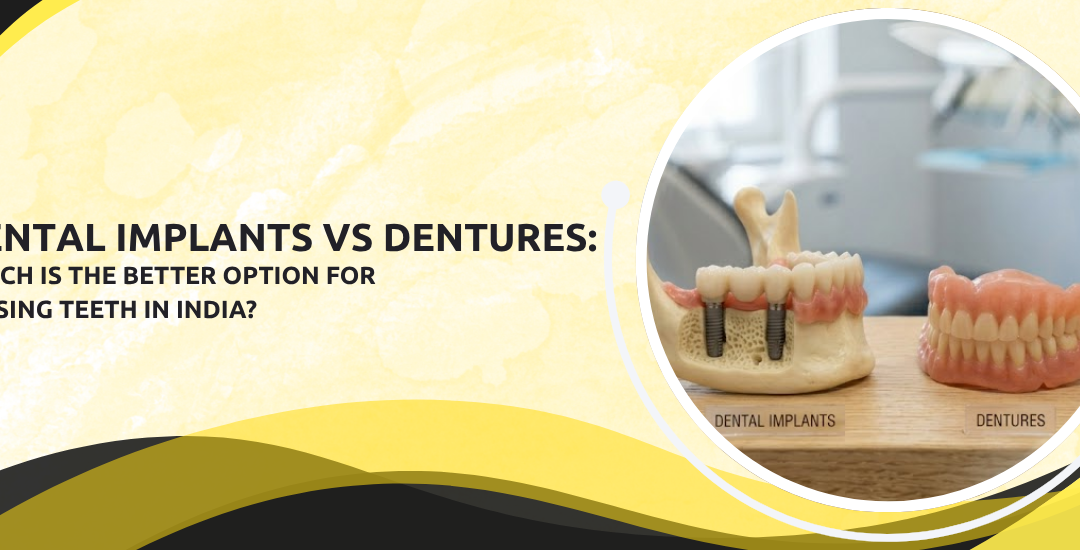
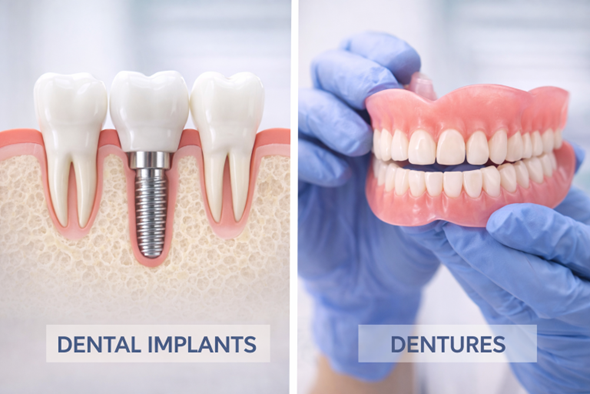
Dental implants. Dentures. One sounds high-tech and expensive. The other sounds, well — older. Like something your nani had. But that picture is outdated, honestly. Dentures today are nothing like what they were fifteen years ago. And implants, while they are an investment, aren’t as out-of-reach as most people assume.
I’ve been treating patients in my dental clinic in South Bopal and across Ahmedabad for years, and the single biggest mistake I see is people deciding between these two options based on price alone — without understanding what they’re actually choosing between. So let me walk you through it properly.
What Are Dental Implants and Dentures?
Here’s the thing about veneers — they’re genuinely tough. Porcelain veneers especially. With proper care they can easily last 10 to 15 years, sometimes even longer. Composite veneers are a bit softer and usually need attention somewhere around the 5 to 7 year mark.
After one year, most people find their veneers still look and feel exactly the same as when they were first placed. That’s the goal. The first year is mostly about your mouth settling in — your bite adjusting, your gums adapting, your cleaning habits getting dialled in around the new surfaces.
If your veneers still feel comfortable and look good at one year, that’s a really positive sign. It usually means the placement was done well and you’ve been taking decent care of them.
How Dental Implants Work: A Permanent Solution for Missing Teeth
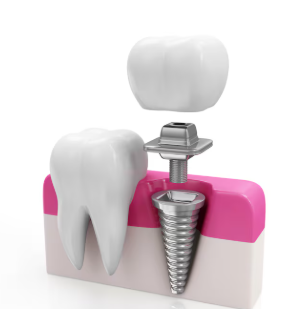
What implants do that nothing else does — and I mean nothing — is replace the root.
People focus on the crown, the visible bit, the tooth you see in the mirror. Understandably. But the crown is honestly the less important part of the equation. It’s the titanium post underneath that does the real work.
Here’s why. Your jawbone is living tissue. It needs stimulation to maintain its density — and that stimulation, under normal circumstances, comes from the pressure a tooth root transmits into the bone every time you chew. When a tooth is gone, that signal stops. The bone in that area starts to shrink. Not overnight. But steadily, month by month, year by year. Patients who’ve had missing teeth for five or more years often have noticeably less bone in those areas — which is actually what causes that slightly hollowed-out look around the mouth that some people associate with ageing.
An implant interrupts this process. The titanium post fuses with the bone — dentists call this osseointegration — and once that fusion is complete, the bone responds to it just like it responds to a real root. The shrinkage stops. The facial structure holds.
For patients considering dental implants in South Bopal or Ahmedabad, this bone-preservation benefit is something I always explain in detail — because it’s often the factor that changes their mind about whether the investment is worth it.
Dentures: An Affordable, Removable Option for Tooth Replacement
I want to be clear: dentures are not a second-rate option. I say this because some of my colleagues overemphasise implants to the point where patients feel almost embarrassed to ask about dentures. That’s not fair.
For the right patient, dentures are an excellent solution. If you’ve lost most of your teeth, if surgery isn’t safe for you medically, if you’re in your late sixties or seventies and simply want functional teeth without a long process — dentures can give you that.
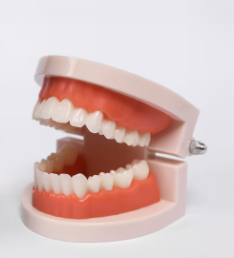
The materials used now produce very natural-looking results. A well-made denture, fitted by someone who knows what they’re doing, can restore both your ability to eat properly and your confidence to smile.
The honest complication with dentures isn’t how they look — it’s the fit over time.
Because dentures don’t replace the root, the bone underneath keeps changing shape after you lose teeth. Which means the denture that fits snugly today will probably feel a bit loose in two or three years. You’ll need relining — basically reshaping the base to match your current bone — every couple of years. And every five to eight years, a full replacement. These visits and costs pile up quietly, and patients often don’t factor them in when they compare upfront prices.
Comparing the Durability of Dental Implants vs Dentures
Straightforward comparison here.
A dental implant placed in a patient with good bone health can last twenty, twenty-five, sometimes thirty years. I have patients who’ve had theirs for over a decade and we’ve touched nothing. Their check-ups are boring in the best possible way — nothing to report, everything looks exactly as it should.
Dentures are typically replaced every five to eight years. They’re also more vulnerable to accidents — if a denture gets dropped on a hard floor, it can crack. Acrylic, even good quality acrylic, is not titanium fused to living bone.
In day-to-day use, there’s a difference too. An implant doesn’t move when you bite into something firm. It doesn’t shift mid-sentence when you’re speaking. There’s no adhesive involved, no adjustment needed depending on what you’re eating. You just — use it. Like a tooth. Because that’s essentially what it is.
Dentures, especially as they age or if the fit loosens, can shift. Not dramatically, not always — but enough that some patients modify what they eat, avoid certain social situations, or develop a subtle self-consciousness that wasn’t there before. I’ve seen this pattern enough times that I mention it upfront now.
The Aesthetic Benefits of Dental Implants and Dentures
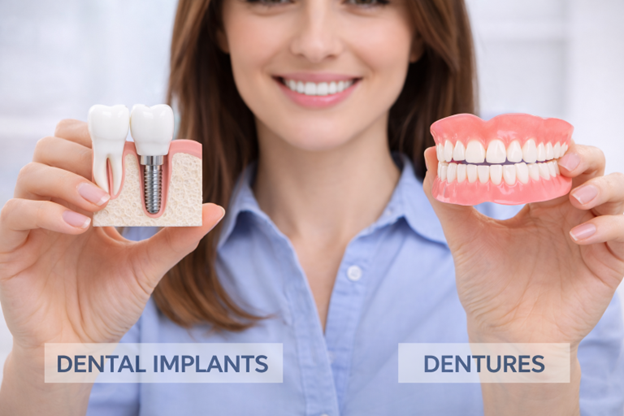
Both look good. I’ll start there.
A good-quality denture, made from decent materials, fitted carefully, looks natural. I don’t want to dismiss that. If you met someone with well-made dentures, you probably wouldn’t know. Modern dental ceramics and acrylics are genuinely impressive.
The implant crown is custom-shaded to match your surrounding teeth. It’s fixed in place, so there’s no micro-movement that catches the light strangely or shifts when you laugh. And — this is the part people don’t always see coming — because the implant preserves the jawbone, your face doesn’t change shape over the years the way it does when bone is gradually lost. Patients with implants tend to look the same in photos five years later. Patients who’ve had dentures for a long time sometimes develop a subtle change in facial contour that’s hard to pinpoint but visible if you know what to look for.
For patients in Ahmedabad in their 30s and 40s — people who have thirty or forty years ahead of them — this long-term facial stability is often the detail that tips the decision toward implants.
Cost of Dental Implants vs Dentures in India: What to Expect
The number people see first is always the per-tooth cost of an implant, and that number — somewhere between ₹25,000 and ₹60,000 depending on the case — does make people pause.
The variation within that range matters. Implant brand makes a real difference. There are internationally certified systems — Nobel Biocare, Straumann, and others — that have decades of clinical data behind them. And then there are cheaper alternatives that, frankly, I wouldn’t put in my own jaw. The upfront cost of a quality implant reflects the quality of what’s going into your bone permanently. That’s not marketing language; it’s material science.
Dentures cost less upfront — a full set runs anywhere from ₹8,000 to ₹30,000 depending on material and design. Partial dentures are less than that. And for a lot of families, that’s the number that matters right now, today, and I completely understand that.
But stretch the calculation to fifteen years. One implant at ₹40,000. Versus dentures that need relining every two years, occasional repairs, and replacement at year six or seven — and then again at year twelve. The gap closes faster than people expect. In some cases, the cumulative denture cost overtakes it. This isn’t a sales argument — it’s just arithmetic, and it’s worth doing before you decide.
Which Option Is Right for Your Lifestyle and Needs?
If I had to distil this down, here’s how I’d put it.Implants make the most sense when you’re missing one tooth or a few, when your bone density is adequate, when you’re in reasonable general health, and when you’re thinking in terms of the next twenty years rather than just the next twenty months. Age matters less than people think — I’ve placed implants in patients in their late sixties with excellent results. What matters more is bone quality and overall health.
Dentures tend to be the better fit when most or all of the teeth are gone, when surgery isn’t advisable for medical reasons — uncontrolled diabetes, blood thinners, certain heart conditions — or when the budget genuinely doesn’t allow for implants right

now. Starting with dentures doesn’t close the door on implants later, either. Many patients begin with dentures and transition to implant-supported solutions after a year or two.
Implant-supported dentures are worth a mention here. Two to four implants anchor a full denture firmly so it doesn’t move. You get the coverage of full dentures with the stability of implants. For patients who’ve lost all their teeth, this is often what I end up recommending — and it’s more affordable than individual implants for every missing tooth.
No article can tell you which option is right for your specific mouth. That genuinely requires a scan and a clinical assessment. But this should at least give you the vocabulary to have that conversation properly.
The Process of Getting Dental Implants: What's Involved?
The word “surgery” scares people off implants more than the cost does, in my experience.
So let me describe what actually happens, not the theoretical version.
First visit — we take a 3D CBCT scan. This isn’t optional or a formality; it tells us exactly how much bone you have, where the nerves sit, what angle the implant needs to go in at. Any clinic skipping this step is cutting corners.
The placement itself is done under local anaesthesia. The procedure takes under an hour for a single implant. Most patients describe the experience as duller than they expected — pressure, not pain. The day or two after involves some soreness, mild swelling sometimes, manageable with regular painkillers. The majority of patients are back to normal activity within forty-eight hours.
Then three to six months of healing. The implant fuses with the bone during this period. We usually place a temporary crown so you’re not sitting with an obvious gap. When osseointegration is complete, the permanent crown goes on — custom-made, colour-matched, fixed. Done.
It’s not fast. But for something that should still be functioning perfectly twenty years from now, the timeline is more than reasonable.
Caring for Your Dental Implants or Dentures: Maintenance Tips
Aftercare is where a lot of patients slip up — with both options.
Implants:
Brush twice daily, treat the crown exactly like a natural tooth. Use an interdental brush or water flosser around the base — regular floss alone often doesn’t reach the margin properly. Come in for six-monthly check-ups without fail. The condition we watch for is peri-implantitis — infection around the implant base — which is very treatable when caught early and much messier when it isn’t. I cannot stress the check-ups enough. This is where long-term implant success is genuinely made or lost.
Dentures:
Remove after eating and rinse. Use a proper denture brush with denture cleaning solution — not regular toothpaste, which is too abrasive and scratches the surface over time. Soak overnight, every night. This maintains the shape and prevents bacterial build-up. And come in when the fit starts feeling off — don’t wait until you’ve developed sore spots. An early reline is a thirty-minute appointment. A fungal infection from a poorly fitting denture sitting on irritated gum tissue is considerably more involved.
Why Choose Dentafix Dental Clinic for Your Tooth Replacement Treatment?
A few things about how we work at Dentafix that I think are worth knowing.
Every tooth replacement case at Dentafix Dental Clinic in South Bopal starts with a proper CBCT 3D scan — not a quick look and a recommendation. We use internationally certified implant systems. Our team has specialists in both implantology and prosthodontics. And we tell patients honestly when dentures are the better fit for their situation — we’re not incentivised to push the more expensive option if it’s not the right one.
Dr. Jahnavi Patel has placed over 1,500 implants and holds advanced certifications from the American Association of Implant Dentistry. The wider team

— Dr. Riya Rathi and Dr. Devhuti Hariyani — brings expertise across multiple dental specialties. Patients from Bopal, Shela, Ambli, Ghuma and across Ahmedabad have been coming to us not just for treatment but for the kind of straightforward advice that’s harder to find than it should be.
Frequently Asked Questions:
Q1. Does getting a dental implant hurt?
Done under local anaesthesia — most patients say the actual procedure was far less uncomfortable than they expected.
Q2. How long does the whole implant process take?
Typically 3 to 6 months from placement to final crown, depending on how your bone heals.
Q3. Can I switch from dentures to implants later?
Yes — choosing dentures now doesn’t rule out implants later, and many patients make this transition.
Q4. What is the success rate of dental implants in India?
95–98% over 10 years with proper planning and aftercare, in line with global outcomes.
Q5. Are modern dentures uncomfortable for daily use?
Well-fitted dentures today are comfortable — ongoing discomfort almost always signals a fit issue that needs adjustment.
Q6. Who might not be a good candidate for dental implants?
Patients with uncontrolled systemic conditions, significant bone loss, or active gum disease may need preparatory treatment before proceeding.
Q7. What do implants cost at Dentafix Dental Clinic, Ahmedabad?
Between ₹25,000 and ₹60,000 per tooth depending on complexity — pricing is discussed clearly at consultation, no surprises.
Q8. Will people be able to tell I have an implant?
Virtually no — the crown is matched to your natural teeth in shade and shape, and it doesn’t move like a denture can.